
How Thick Should a Concrete Driveway Be?
Short answer. Concrete Network's general guidance is at least 4 inches of concrete for passenger cars and SUVs, and 5 to 6 inches with rebar for a heavy truck or a large RV. Citing the Tennessee Concrete Association, it says the step from 4 to 5 inches raises load capacity by nearly 50 percent. On a real driveway, thickness and steel are set for that site and its plans: the soil, what will drive on it and what the city requires.
Thickness is the one part of a driveway you cannot add later, so it is worth understanding before the forms go up. This guide covers what published industry guidance says for each kind of vehicle, and the other parts of the slab that guidance talks about: the base, the steel, the joints and the edges. On the driveways we pour, thickness and steel are set for each site and its plans, so read the figures here as background and not as a bid.
What the guidance says for cars, trucks and RVs
Concrete Network, the industry publisher, says thickness is the major factor in a driveway's structural capacity, more than the strength of the concrete itself. In its guidance, 4 inches is the starting point and what parks on the slab decides the rest. Its figures by vehicle are below.
| What uses the driveway | Thickness (Concrete Network) | Reinforcement (Concrete Network) | Notes |
|---|---|---|---|
| Passenger cars and SUVs, about 3,000 to 6,000 pounds | 4 inches minimum | Wire mesh | The standard residential slab |
| Loaded pickup, work truck or regular delivery traffic | 5 inches | #4 rebar on a grid of about 12 inches | Nearly 50 percent more load capacity than 4 inches |
| Large RV or motorhome, which can weigh 12,000 pounds or more | 5 to 6 inches | #4 rebar on a grid of about 12 inches | Thicken the pad where it parks if the rest stays at 4 |
| Apron at the street | Set by the city or county | Per the agency's standard plan | Public right of way, so the agency's rules apply |
Those figures are Concrete Network's general guidance, not a code table, and it says plainly that local soil can call for more. That is the point of the table: the right thickness for a driveway comes from the site, the vehicles and the plans, and it is set for each job.
Form boards are not a measure of thickness. Lumber is sold by a nominal size, and the grade inside the forms decides how thick the slab ends up.
Why heavier vehicles change the guidance
By the Tennessee Concrete Association figures Concrete Network cites, going from 4 to 5 inches adds close to 50 percent to a slab's load capacity. That is why the guidance steps up when anything heavier than a car will use the driveway.
Think about the vehicles that visit, too. A moving van, a loaded dumpster truck or a ready mix truck for a later backyard project weighs far more than anything you own. Tell us at the estimate what will use the driveway, so the plan fits it.
What goes under the slab?
Evenly compacted soil, and in many yards a layer of crushed rock. Concrete Network calls uniformity, in both soil type and compaction, the key to a good subgrade. Soft pockets found during grading are usually dug out and filled with gravel or crushed rock.
On expansive soil, the clay that swells when wet and shrinks when dry, the same source calls for 2 to 8 inches of crushed rock depending on how expansive the soil is. That matters here. The City of Los Angeles building department treats all soil in the city as expansive unless an approved soils report shows otherwise. The base under each driveway is set by its soil and its plans.
Ask each contractor what thickness, base and steel their bid is based on, and why. Those are set for your site and its plans, and the answers tell you whether two bids are for the same driveway.
Rebar or wire mesh?
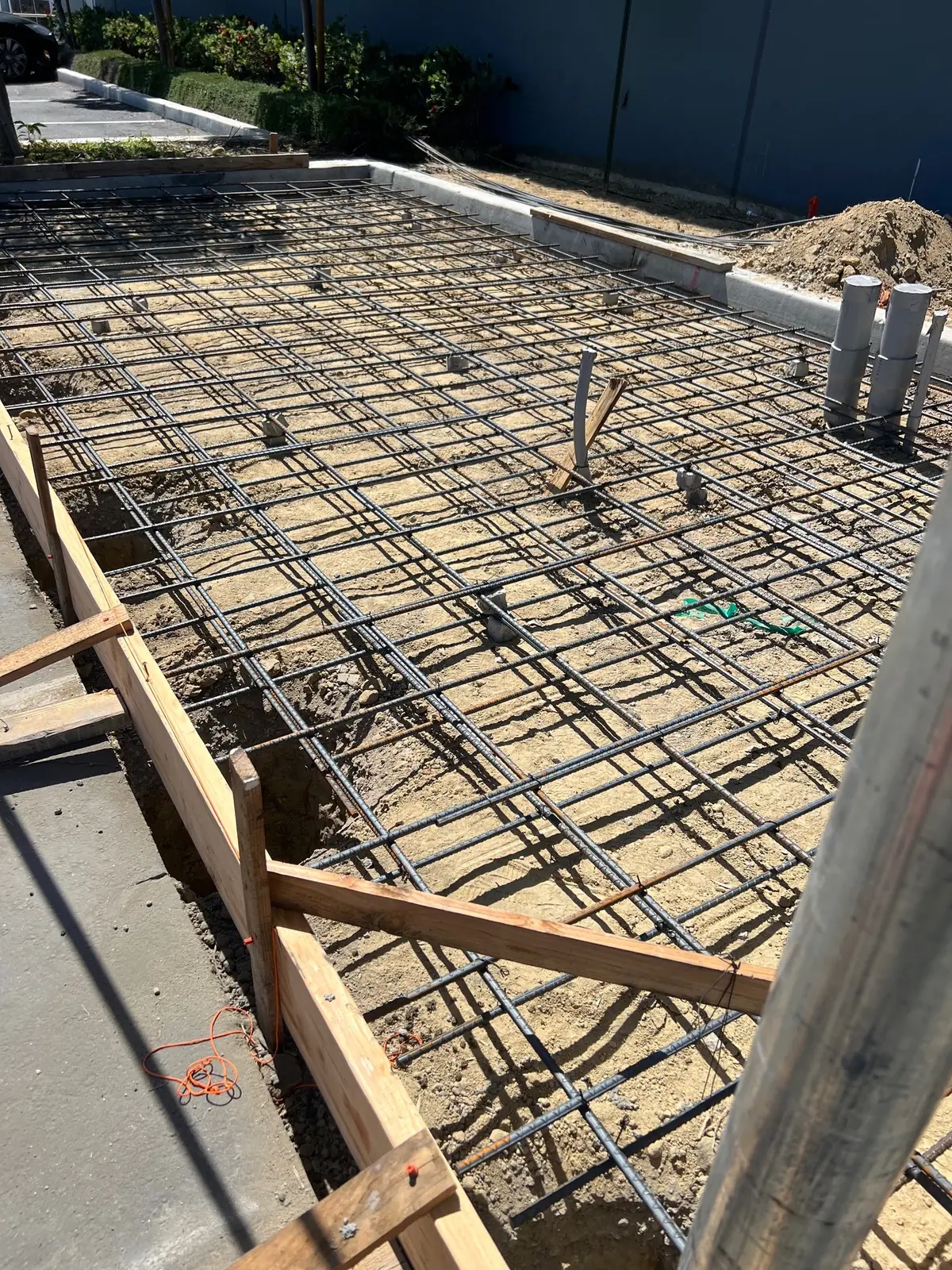
Concrete Network's general rule is mesh for 4 inch slabs and rebar for 5 inches and up, with #4 bar, which is 1/2 inch thick, laid in a grid about 12 inches apart. What goes into a given driveway is set by its site and plans.
Either kind of steel belongs inside the slab, not on the dirt under it, which is why it is propped on small blocks before the pour.
Where do control joints go?
Control joints are a normal part of a concrete driveway, and their layout is set for each slab. NRMCA's guide to joints in slabs on grade gives a rule of thumb of 24 to 36 times the slab thickness, and never more than 15 feet apart, which the guide puts at about 10 feet for a 4 inch slab.
- Depth. The same guide calls for a joint at least one quarter of the slab thickness deep.
- Shape. NRMCA wants panels square or close to it.
- Isolation joints. Where the driveway meets the garage slab, the sidewalk or other existing paving, a strip of joint material lets each slab move on its own.
Thickened edges, slope and mix
A wheel at the edge of a slab has concrete on only one side of it, which is why Concrete Network suggests thickening the edges by 1 to 2 inches, with the thicker band running 4 to 8 inches in from the edge. Whether a driveway gets thickened edges is part of the plan for that site.
For drainage, the slab should fall toward the street and away from the house at 1/8 inch per foot or more, a figure Concrete Network attributes to the Portland Cement Association. If the driveway runs downhill to the garage, plan a channel drain before the pour.
Mix strength follows the plans, or the supplier's driveway mix where there are no plans. Adding water at the truck to make the concrete easier to place weakens it, whatever was ordered.
Ikon Concrete Design pours concrete driveways across the San Fernando Valley and Santa Clarita, and handles the demolition when an old slab has to come out first. Every driveway is different, and we work out the thickness, base and steel for yours once we have seen the site. The estimate is free: call or text (818) 464-5763 or send a message.
More questions
Concrete Network's guidance treats 4 inches as the standard residential slab for cars and SUVs and steps up to 5 inches with rebar for a loaded pickup or work truck. By the Tennessee Concrete Association figures it cites, that extra inch adds nearly 50 percent more load capacity. Tell us at the estimate what you drive and haul, because thickness and steel are set for each site and its plans.
Concrete Network's guidance is 5 to 6 inches with rebar, and it notes a large RV can weigh 12,000 pounds or more, about twice a heavy SUV. Its guidance also allows thickening only the lane and pad where the RV travels and parks. The thickness for your pad is set by the site, the RV and any plans the city requires.
Not as a way to add thickness. Raising the surface changes how it meets the garage and the sidewalk, and an old slab that has sunk or broken up usually has to come out so the base under it can be fixed.
No. Concrete Network says synthetic fibers do not provide structural reinforcement. Fibers can go in the mix along with steel, not in place of it.
Related services
Written by the Ikon Concrete Design team in Sylmar, California. Ikon Concrete Design is a family owned concrete contractor run by Gilbert Rico since 1999, California license770901. This article is general information. Codes, fees and prices change, so check with your building department and get an on-site estimate before you plan around a number.
Concrete contractor in Santa Clarita and the San Fernando Valley
Family OwnedSince 1999
California contractor license 770901. C-8 Concrete and B General Building. Free estimates.
Get Your Concrete Poured In Three Easy Steps
Send A Message
Call, text or send the form with a few details, and photos if you have them. We reply the day we get it.
Step 1Free Estimate
We walk the site with you, measure, talk through finishes and drainage, and give you a price. No charge.
Step 2We Build It
Most jobs start about two weeks after you approve the estimate. We demo, form, pour, finish and haul off the mess.
Step 3
Ready For Your Concrete Project?
Family owned since 1999. California license 770901. Free estimates.