
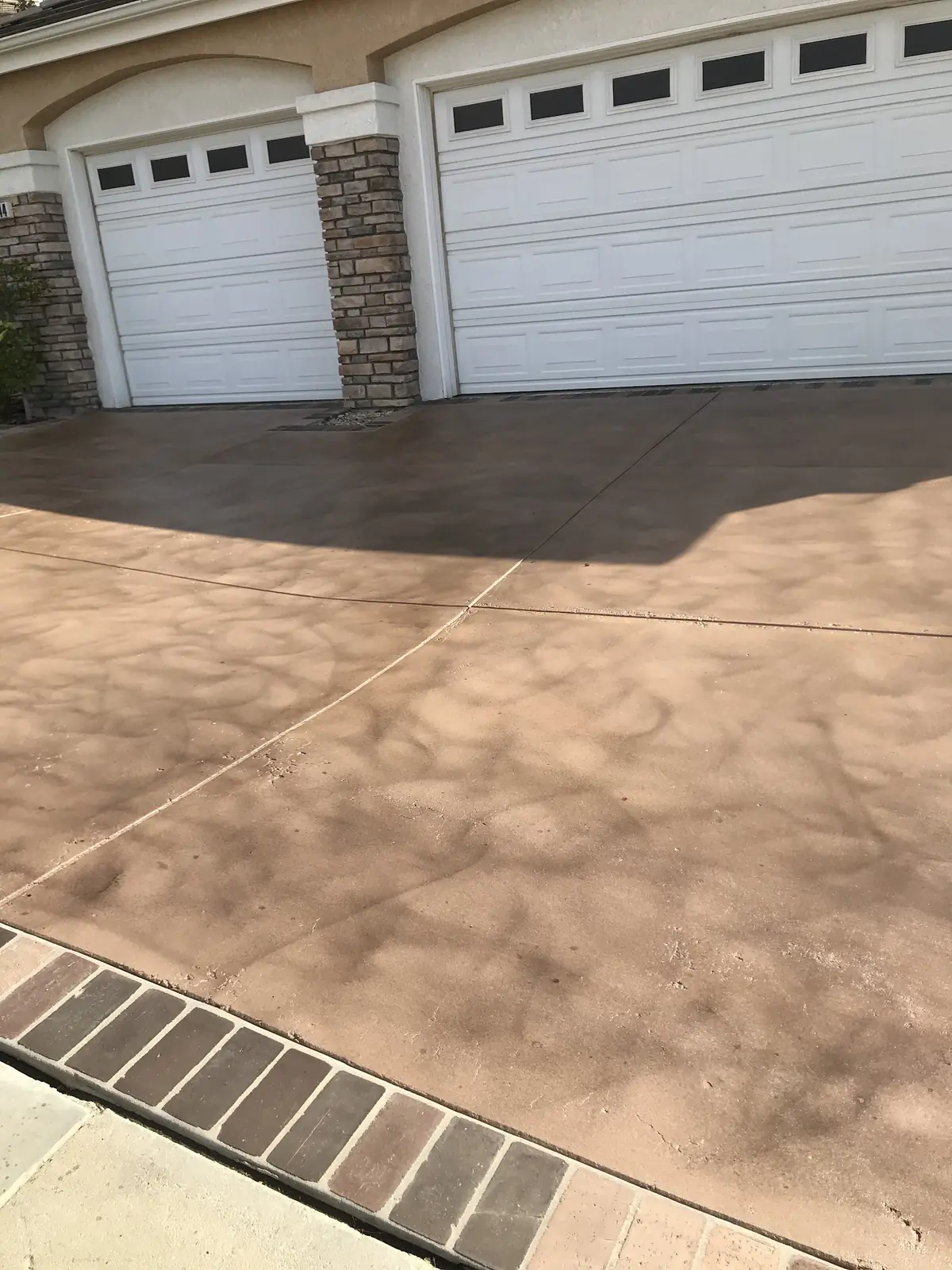
Acid Stain vs Water Based Stain for Concrete
Short answer. Acid stain is a solution of metallic salts that reacts with the lime in concrete and leaves mottled earth tones in the surface itself. Water-based stain carries fine pigment into the pores with no reaction, so it comes in more colors and works on old slabs that acid will not color. Outdoors, acid stain handles sun and tires better. Both have to be sealed.
Both products color concrete that is already cured, and both are translucent, so the slab shows through. They get there by different chemistry, and the chemistry decides where each belongs. What follows comes from manufacturers' data sheets, mainly Sika's, checked against Euclid Chemical and Brickform. Brands differ, so the sheet for the product used on your job is the one that counts.
How each stain works
Acid stain is a chemical reaction
Sika's data sheet describes its acid stain as a corrosive, acidic solution of metallic salts. Sprayed on cured concrete, it reacts with the free lime in the surface and leaves colored mineral deposits in the pores. The stain should fizz when it lands. If it does not, the sheet says the slab needs more cleaning or is too old to react.
Because the color is made by the concrete, it changes with the mix, the age and how hard the surface was troweled. The sheet tells you to expect wide variation, mottling and unevenness within one slab and from one slab to the next. The reaction needs at least 4 hours. After that the acid residue is neutralized, scrubbed and rinsed off, because residue left under a sealer makes the sealer let go.
Water-based stain is pigment that soaks in
Water-based stain reacts with nothing. It is very fine pigment in water, sprayed so it soaks into the pores. Sika's sheet says the product is formulated to permeate a properly prepared surface and to stand in for acid stain where concrete is minimally reactive, or where the color wanted cannot be made with acid. It contains no acid, so there is no neutralizing step.
Everything depends on it getting in. A hard-troweled or sealed slab has to be sanded or cleaned until drops of water soak in and darken it. Stain put on so heavily that it dries as a film on top can delaminate or peel, according to the same sheet.
Acid stain and water-based stain side by side
| Acid stain | Water-based stain | |
|---|---|---|
| What it is | Acidic solution of metallic salts | Fine pigment in water, no acid |
| How it colors | Reacts with free lime and leaves mineral deposits | Soaks into the pores, no reaction |
| Standard colors | Earth tones. Sika 10, Brickform 10, Euclid 9 | Wider range. Sika 18, Brickform 12, and they can be blended |
| Concrete age (Sika) | At least 21 days | Cured 28 days |
| Temperature limits (Sika) | Slab at 50 to 90 degrees | Slab and air at 50 to 85 degrees |
| After it goes on | 4 hours minimum, then neutralize and rinse | No neutralizing. Keep water off for 36 hours |
| Sunlight | Color does not fade | Most colors resist fading, with exceptions |
| Vehicles | Euclid lists driveways and garage floors among its uses | Sika says not for areas with vehicle traffic |
Where each one fails
Acid stain fails when there is nothing for it to react with, or when water gets at the wrong color.
- Old or weathered concrete. Sika warns that it may not be effectively colored, and that concrete containing reactive pozzolans may not accept the stain at all.
- Patches. Repair material may not react, or may come out a distinctly different color from the slab around it.
- Blue-greens outdoors. Sika limits three of its ten colors, the green, copper and bronze tones, to interior use because they may blacken when rain or sprinklers wet them.
- Acid-washed slabs. The sheet says not to clean with an acid solution before staining.
Water-based stain fails under wear, and when it sits on the surface instead of in it.
- Driveways. Sika says its water-based stain should not be used in areas subject to vehicular traffic, and does not recommend it for high traffic, abrasion or immersion.
- Heavy coats. Extra material that hardens as a film can peel.
- Dirty or sealed surfaces. Release agent, curing compound, old sealer and oil all block it.
Neither one hides anything. Oil spots, old repairs and other marks in the slab show through both.
Sealer and UV in Southern California sun
The stain is rarely what gives out in the sun. Euclid and Sika both state on their data sheets that the color of their acid stain does not fade from UV light. Sika rates most of its water-based colors as resistant to fading from sunlight but bars two of them, a red and a purple, from any surface exposed to sunlight. Ask whether the color you like carries a note like that before it goes on a south-facing patio.
The sealer is the part that wears. Sika's sheet says all concrete sealing compounds will eventually show the effects of weathering and traffic, and that hot tires, or tires turned while the car is standing, may damage a sealer. When a stained slab looks faded, a dull or whitened sealer is the first thing to check.
Heat limits the work itself. Sika's sheets cap slab temperature at 90 degrees for the acid stain and 85 for the water-based stain and for the solvent-based sealer it pairs with them. The normal August high is about 97 degrees in Woodland Hills, and a surface in full sun runs hotter than the air. An Arizona pilot study cited by the U.S. EPA measured conventional paving such as asphalt at up to 152 degrees at midday. In a San Fernando Valley or Santa Clarita summer, that usually means working in the early morning.
One local rule narrows the choice of sealer. South Coast AQMD Rule 1113 caps waterproofing sealers for concrete and masonry at 100 grams of VOC per liter, and the district includes the City of Los Angeles. Ask which sealer is on your estimate and whether it is sold for this air district.
Ask for a test patch on your own slab, stained and sealed, before you approve a color. Sika's data sheets for both kinds of stain call for a mock-up on the actual surface, because the same stain comes out differently on every slab.
Which stain for which job
- Driveway or garage floor: acid stain, under a sealer made for vehicle traffic.
- Patio or walk in tan, amber, brown or terra cotta: acid stain, if the slab still fizzes on a test spot.
- Old slab that will not react: water-based stain.
- A color outside the earth tones, outdoors: water-based stain, in a color the maker rates for sunlight.
- Interior floor: either. Water-based stain leaves no acid residue to rinse out of a finished house.
- A touch-up over old acid stain: Sika lists its water-based stain for use over acid stain that has been neutralized, so the two can be layered.
Where Ikon fits in
We apply both as part of our concrete staining work on driveways, patios, pool decks and interior floors, and a slab too marked up for stain can get a resurfacing overlay first. Estimates are free: call or text (818) 464-5763, or send a message with photos of the slab.
More questions
For exterior concrete that takes sun and cars, usually yes, because the color is a mineral deposit in the surface and not a pigment. Water-based stain is the better choice when the slab is too old to react or you want a color outside the earth tones.
Sika and Euclid Chemical both say their acid stain color does not. Most water-based colors resist fading, but Sika bars two of its colors from sunlit surfaces. What dulls first on any stained slab is the sealer.
Sika's data sheets call for concrete at least 21 days old for its acid stain and a 28 day cure for its water-based stain. Curing compounds that leave a film should not be used on a slab that will be stained.
Yes. Sika lists reactive chemical stains, once neutralized, among the surfaces its water-based stain can go over. The slab still has to be clean, dry and free of sealer for the new color to soak in.
Related services
Written by the Ikon Concrete Design team in Sylmar, California. Ikon Concrete Design is a family owned concrete contractor run by Gilbert Rico since 1999, California license770901. This article is general information. Codes, fees and prices change, so check with your building department and get an on-site estimate before you plan around a number.
Concrete contractor in Santa Clarita and the San Fernando Valley
Family OwnedSince 1999
California contractor license 770901. C-8 Concrete and B General Building. Free estimates.
Get Your Concrete Poured In Three Easy Steps
Send A Message
Call, text or send the form with a few details, and photos if you have them. We reply the day we get it.
Step 1Free Estimate
We walk the site with you, measure, talk through finishes and drainage, and give you a price. No charge.
Step 2We Build It
Most jobs start about two weeks after you approve the estimate. We demo, form, pour, finish and haul off the mess.
Step 3
Ready For Your Concrete Project?
Family owned since 1999. California license 770901. Free estimates.